


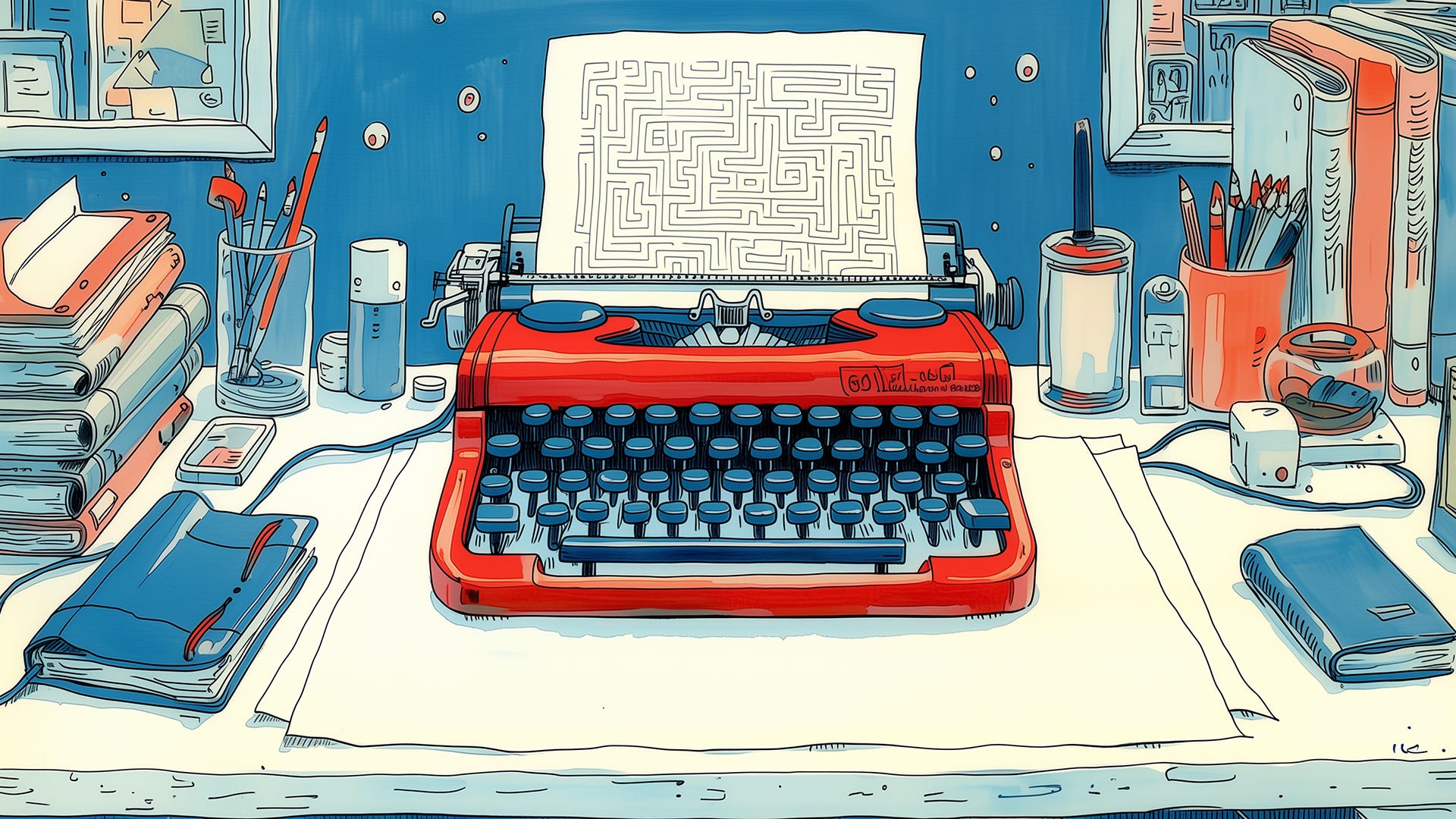
I’ve spent my entire design career believing that concepts direct the work. The image comes second. First you figure out what you’re trying to say, then you figure out how to visualize it. That conviction—while king in branding and advertising—used to feel like a minority position in the product design field obsessed with craft and production. It doesn’t feel like a minority position anymore.
Something has shifted. The “pure void concept” that Elizabeth Goodspeed uses to describe her creative process—words and intentions, not mental images—turns out to be a decent description of where the whole profession is heading. A product designer at Anthropic describes his daily reality as “more Google Docs than you’d think , more Slack posts than you’d think... this is the era of designers who design with words more so than designing with pixels.” The Figma work, Nate Parrott says, is “the easy part.” Content designers on his team don’t draw any pixels, and their work is critical.
So the center of gravity is moving from visual production to verbal and conceptual work. For someone who’s been concept-first since my design school days, this feels less like disruption and more like recognition. But I’m not celebrating. Because there’s a dangerous conclusion lurking inside this shift, and I’m watching people reach for it: if words drive the work and machines handle the pixels, maybe the eye doesn’t matter anymore.
It matters more. The eye just gets reassigned. Jakob Nielsen calls this the evaluability bottleneck: “In intent-based systems, execution is cheap, but evaluation becomes the bottleneck.” When an agent can generate forty layout variations before lunch, the person who can look at all forty and know which three are worth pursuing holds the real leverage. That’s trained visual discernment, not prompt engineering.
That separation of taste from execution is already happening. Jenny Wen, who leads design at Claude, has her designers shipping code and fixing production bugs without tagging engineers. Tommy Geoco, host of State of Play, summarized her argument: “having taste versus being able to execute are two completely different things. They’re usually bundled together, but they don’t have to be.” And on the tools side, Figma is finally opening its canvas to agents, with design conventions becoming “rules agents follow as they work.” The agents read skills files before touching anything. But someone still has to look at what comes back and decide if it’s any good.
That’s the part I’m genuinely worried about. I’m seeing designers hand the evaluation to the machine along with the production. They let the agent run and ship what it returns without a second look. Kris Puckett, a design manager at Stripe, explicitly rejects this: “I want them to be focused. I want it to be something that I feel is still authentically me.” He calls that quality “soul”: the thing that makes work yours and not just adequate.
Creative fluency compounds on itself. Brad Frost, the web designer and design systems author, makes the analogy to music: “Just as being able to play piano puts you in a better spot to wield a synthesizer.” An eight-year-old can vibe-code a game. A seasoned designer can vibe-code one that actually works, because they know what good looks like. And that sensibility survives the tool change. Dora Czerna, writing for UX Collective, puts it cleanly: “The pattern isn’t that expertise becomes worthless. It’s that expertise gets unbundled from the tasks that used to contain it.”
Last week I argued that the value of design is concentrating at the edges: deciding what to build and judging what was built, with agents owning the middle. Those edges turn out to be increasingly verbal and conceptual. But the eye stays. The designers who lose won’t be the ones who learned to articulate intent in a Google Doc instead of a Figma file. They’ll be the ones who stopped looking.
Happy 50th Birthday, Apple
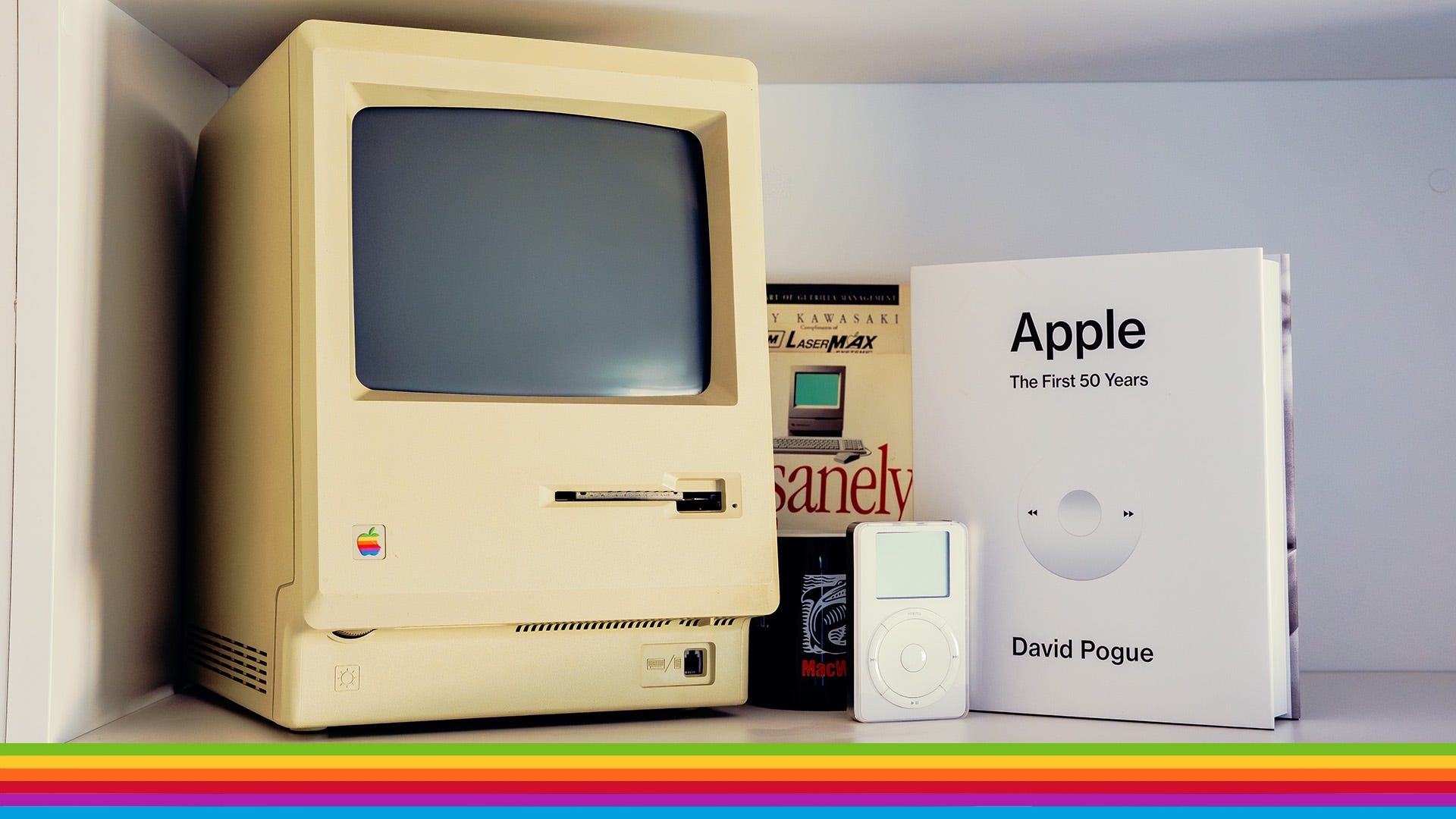
I went to grade school at a parochial school in San Francisco’s North Beach. It was full of mostly middle class, neighborhood kids—an assortment of Italians, Chinese, and Filipinos from a ten-block radius. Half our teachers were nuns who lived in the convent on the same block. The other half were laypeople. To my surprise and delight, we had a computer lab back in the early- to mid-1980s, filled with maybe ten Apple IIe computers. It was seventh grade when I was allowed to take the class. Most computer classes at the time taught rudimentary programming in BASIC. This was a few years after I had watched the movie TRON on the big screen. And right after I had gotten my first Mac.
A few months into the class, in January, on a typical cool day in The City, I was in the computer class when the principal announced over the PA that a tragedy had struck the crew of the space shuttle Challenger. The group of us ran to the classroom where there was a television mounted at the corner. We watched the news report and the replay of the explosion—a trail of white smoke that split into a Y.
That image must have stuck with me because—well, what would a 12-year-old boy do but want to animate the launch and explosion. As my final project for my computer class, I made an animation of the launch. I mapped it out on grid paper first, and then painstakingly transferred those sprites pixel by pixel and frame by frame to the Apple IIe in my program. Over the course of days—weeks?—I typed in numbers for coordinates and letters for colors, and saved my work to a floppy disk.
Come finals time, I played the animation for my class and got some oohs and ahs. Looking back at it now, it was a dumb and tone-deaf idea. I should have animated a lamp jumping on a ball or something instead.
Anyway, that was an Apple memory I haven’t shared before on this blog. Happy birthday, Apple. Thanks for 50 years of empowering crazy people like me to make crazy things.
Some favorite Apple-related posts I’ve written:
The Apple Design Process. My memory of working at Apple’s Graphic Design group during the time of the iPod and the PowerMac G5.
For the Rest of Us. Apple has always done well in its marketing and advertising. This is my reflection on one of my favorite Apple spots.
30 Years of Mac. Don’t judge, but this is the first thing I ever drew on a Mac.
Thank You, Steve. Here I share the story of one of the times I presented to Steve. This was an animation for MacBuddy, the Mac OS X setup assistant.
What I’m Consuming
Apple II Forever! Jason Snell traces the full arc of the Apple II, from its 1977 launch through its stubborn refusal to die even as Apple kept trying to replace it with the III, the Lisa, and the Mac. The best detail: the Apple IIe wasn’t discontinued until 1993, meaning people were still buying Apple II computers in the era of Nirvana’s Nevermind. (Jason Snell / The Verge)
I’ve been stealing from all of you, and I don’t plan to stop. Claire Alvis writes about the distance between plagiarism and inspiration, starting with a colleague’s verbal tic that migrated into her own vocabulary without her noticing. She maps the full spectrum from outright theft to pure osmosis and lands on a generous conclusion: admitting your influences publicly is its own form of credibility. (Claire Alvis)
Harness design for long-running application development. Anthropic’s Prithvi Rajasekaran describes a multi-agent system for getting Claude to build complete applications autonomously. The relevant insight for designers: when asked to evaluate their own work, AI agents consistently praise mediocre output, especially on subjective quality like visual design. The fix was separating the builder from the judge, with a dedicated evaluator agent that screenshots the running app, clicks through it, and grades against specific design criteria. It’s the evaluability problem applied to the machines themselves. (Prithvi Rajasekaran / Anthropic)
DNS Explained. Manish Bhusal couldn’t figure out why his site kept showing the old version after a server migration. Three hours of frustration later, he’d learned about TTL, DNS propagation, and the full resolution chain from root servers to your browser cache. A clear, personal walkthrough of how DNS actually works, written by someone who just figured it out the hard way. (Manish Bhusal)