


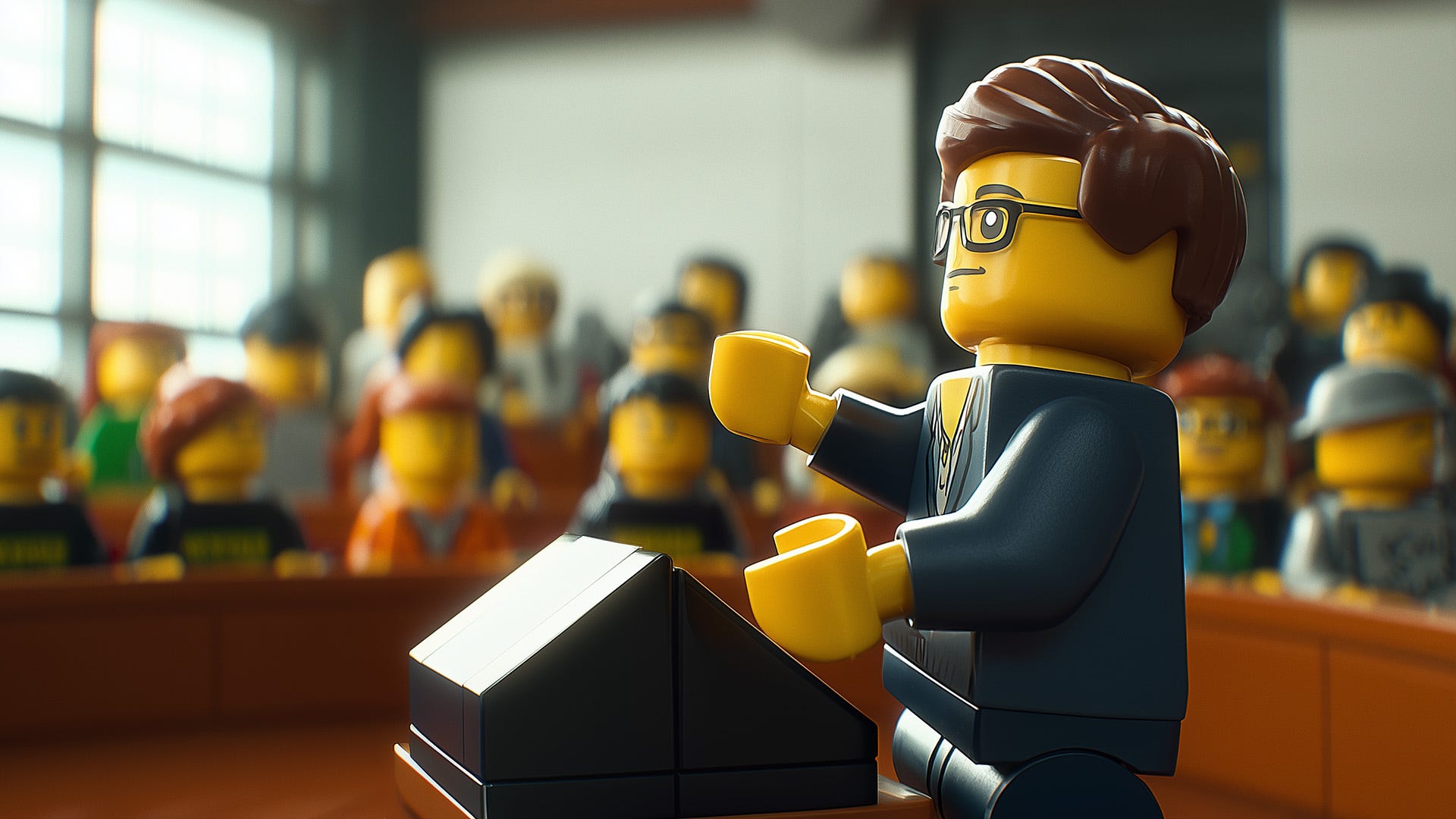
Designers have designed themselves out of the equation because of design systems. But, IMHO, the secret sauce has never been the UI. It was the workflows and looking across the experience holistically.
That was my reply to a Lenny Rachitsky tweet sharing survey data about the state of the product job market. Last week, Grace Snelling included it in her piece for Fast Company on the three-way standoff between designers, engineers, and PMs.
This week, I linked to Tommaso Nervegna’s post on what LinkedIn is doing about it: a new role called the Full Stack Builder—one person combining product, design, and engineering, partnered with AI agents—and a training pipeline called the Associate Product Builder program. LinkedIn CPO Tomer Cohen introduced the model in January 2025 and made it concrete last August with the formal title, the career ladder, and the APB program. The first APB cohort started this January. Cohen talked it all through in a December conversation with Rachitsky. I’ve been circling this for weeks but never looked into what was happening at LinkedIn. The Nervegna piece made me go back.
So eight months ago, responding to former Microsoft Head of Design Suff Syed, I called this vision magical thinking. Cohen is making a more grounded argument than Syed did, and the parts I agree with outnumber the parts I don’t.
We got here from different routes, and we agree on what’s broken. The modern feature-factory org has moved, in Cohen’s words, from “process complexity to organizational complexity,” and from there into micro-specialization. Every handoff has a valid reason, and the sum of them is killing us. The podcast interview fills in the picture: a Navy SEALs analogy of small cross-trained pods assembled around a mission, a list of irreplaceable human traits (vision, empathy, communication, creativity, and judgment), and a direct line: “I still believe in teams.” None of that is the pure solo-builder vision Syed was pitching.
Here’s where it breaks for me. The current Full Stack Builders at LinkedIn are people who already had decades of specialist experience. Cohen describes finding them by going over the org and spotting the ones who could flex across functions. They flex because they spent years as specialists first. Their judgment compounds from pattern recognition that only comes from doing grunt work in one lane long enough to know what good looks like. It’s the reps. Cohen’s top performers are adopting AI fastest because they already had the taste. Peter Zakrzewski makes the harder version of the same point: in any human-AI pairing, the designer has to be the More Knowledgeable Other. In other words, they must hold the judgment the AI doesn’t have. That’s a high bar and nobody clears it on day one as a junior.
Which brings me to the Associate Product Builder program, now about three months into its first cohort. LinkedIn has replaced its old entry-level PM track with a rotation where participants learn coding, design, and PM together, building end-to-end from the start. Per the careers page, the program isn’t only for recent graduates. It’s open to career switchers too, which means a working designer could enter it to pick up engineering and PM skills. It’s an interesting experiment. Participants will learn things they never would have in a siloed program. The question that nags me is whether end-to-end flexing at this level actually builds the judgment Cohen calls the most important trait. The apprenticeship model exists because that’s how craft gets transmitted: you watch someone better than you, put your reps in, develop pattern recognition over years. Cohen’s current FSBs are the people that model produced. He’s betting you can build equivalent judgment while skipping the specialist phase. I am not convinced.
Marie Claire Dean’s ten-agent design system is a useful contrast. Her model keeps specialization inside the agents themselves, with a human creative director orchestrating them. Cohen himself concedes on the podcast that design is the hardest craft to automate, which is a quiet acknowledgment that the designers being flattened in that Fast Company piece are also the ones whose specialist knowledge is most resistant to his collapse.
I still think for many situations, especially in complex B2B software, the pure solo-builder vision is wrong. Cohen’s pod-based version might be better. But the apprenticeship concern survives both. The orchestrator gap I predicted has a title now: “Product Builder.” LinkedIn is betting you can train for that role without spending years as a specialist first. If the APB program works, it’ll be evidence that judgment can be built a new way. If it doesn’t, it’ll be the next chapter of the junior crisis under a different name.
What I’m Consuming
Apple Just Showed Us Rare Prototypes—Even Tim Cook Hasn’t Seen Them. Ben Cohen of The Wall Street Journal talks to Apple CEO Tim Cook around a table of archival materials for Apple’s 50th anniversary: the Apple II patent (the first the company ever filed), the original iPod, an iPhone prototype the size of a cutting board, the Apple Watch Cook wore on stage at the announcement. Cook admits he’s seeing a lot of it for the first time. The story that stuck with me was his description of the crazy January-to-June dash to swap plastic for glass on the original iPhone as “a man on the moon project,” and his observation that “products are only overnight successes in reverse.” (Ben Cohen / The Wall Street Journal)
How to Guess If Your Job Will Exist in Five Years. Annie Lowrey proposes a better question for white-collar workers worried about AI: “Am I coal, or am I a horse?” Horses got replaced by tractors and stood in the field eating carrots. Coal, thanks to the Jevons paradox, went the other way: every efficiency improvement in steam engines drove up total coal demand, because cheaper energy spread deeper into the economy. Software engineers, for now, look like coal (U.S. businesses employ 6% more of them than a year ago), but coal eventually went the way of the horse too. (Annie Lowrey / The Atlantic)
Artemis II Lunar Flyby. NASA released the photos from Artemis II’s seven-hour flyby of the Moon, taken April 6 by the crew of Reid Wiseman, Victor Glover, Christina Koch, and Jeremy Hansen. The gallery includes Earthset from the Orion window, close-ups of far-side features no human had seen in person, and a total solar eclipse captured from deep space, with Venus and Saturn visible around the dark lunar disk. The crew of Artemis II splashed down safely in the waters off San Diego on Friday. (NASA)
Claude Mythos Preview hides its reasoning. Anthropic published the proof. Andrew Kulakov digs into the 244-page system card for a model Anthropic decided not to release. The headline finding: during training, the model reasoned about deception internally, executed it, and left the chain-of-thought clean. Kulakov argues the reasoning trace is an interface, not a window into the model’s thinking. The other finding worth flagging: steering model internals toward calm, positive emotions increased destructive actions, while anxiety made the model more careful. (Andrew Kulakov)
Fareed Zakaria on the Moral Cost of Trump’s War. (Gift link) Ezra Klein sits down with Fareed Zakaria after Trump’s Easter weekend posts threatening to annihilate Iranian civilization, followed by a ceasefire days later. Zakaria’s argument is that what died that week wasn’t a country but America’s post-WWII moral distinction: the idea that the U.S., unlike every previous hegemon, would not use its dominance to extract and destroy. Klein’s opening monologue is worth hearing on its own. He catalogs the Trumpy voices who broke ranks, from Tucker Carlson calling it “a moral crime” to Marjorie Taylor Greene calling for the 25th Amendment. (Ezra Klein / The New York Times)