



This week, Anthropic shipped new plug-ins for Claude Cowork—the kind that review contracts and run financial analysis, work that software companies have built entire businesses around. The stock market noticed. Salesforce, Intuit, and ServiceNow all dropped double digits; the IGV software index is down roughly 30% from its September peak. If AI can do the work directly, the tools that organized the work are worth less. Or so the market thinks.
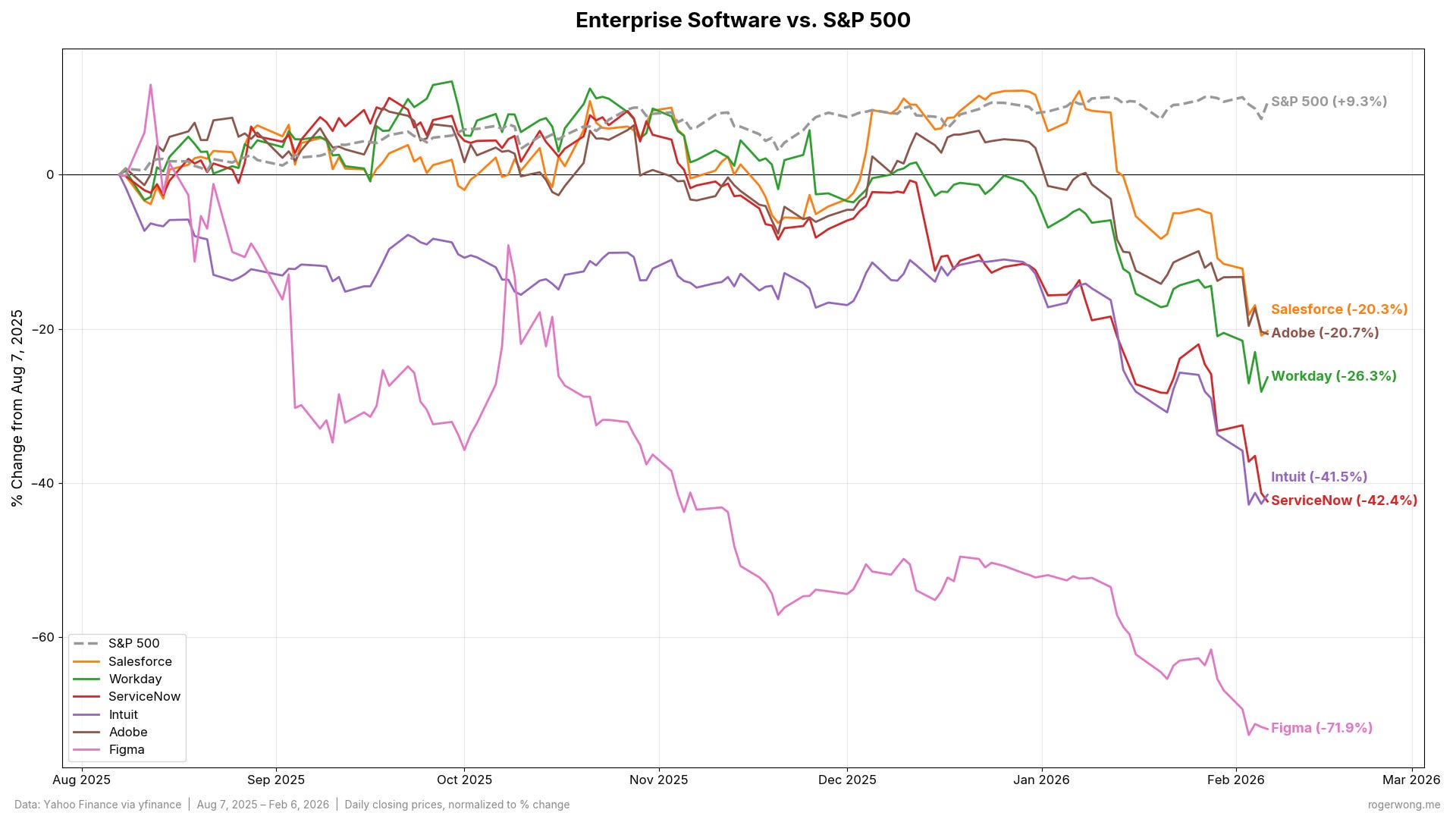
That’s the macro story. The micro version has been showing up in everything I linked to this week. In the not-so-distant past, the startups that survived were the ones that shipped fast. Build and deploy faster than your competition, you won. That was the moat. With Claude Code, Codex, Antigravity and other agentic coding tools, teams can now ship in weeks what used to take quarters. And the result is that a lot of teams are building the wrong things faster than ever.
Gale Robins opened the week with a scene I’ve watched play out from both sides of the table: a team ships three features on time, hits all their velocity metrics, and can’t answer the question “what problem do these features solve?“ She walks through 19 specific judgment points in the product discovery process where human decisions determine whether teams build the right thing or waste months on the wrong one. Her point: AI didn’t eliminate the need for those decisions. It just compressed the timeline so the cost of skipping them shows up faster. Christina Wodtke made the same case from the research side—a designer spent two weeks vibe-coding a gratitude journaling app with confetti animations and gentle notifications, showed it to users, and learned that nobody journals. Two weeks building the wrong thing. Wodtke’s advice: sit down with five to ten people, shut up, and listen. You’ll build less. It’ll be the right thing.
Nielsen Norman Group’s annual State of UX report extended this to the interface itself. Design systems standardized the components; AI-mediated interactions sit on top of the screen. Polished UI is no longer a differentiator. Anyone can produce a decent-looking interface now. Kai Wong interviewed 22 design leaders who all said some version of the same thing: a PM went to an AI tool and came back with something that looked 90% done to an untrained eye. The superpower didn’t disappear. It just stopped being rare enough to carry a career.
So where does our value as designers go? Deeper. Into the work that’s hardest to see and hardest to automate: research, judgment, the ability to articulate why this interface works and tie that explanation to a business outcome. I see this on my own team. The designers who are hardest to replace aren’t the ones who produce the most polished screens. They’re the ones who can walk into a room with a PM and an engineer, explain why something needs to change, and connect that explanation to what users actually do. That skill has always mattered, but it used to be a nice-to-have on top of solid craft. Now it is the craft.
The trouble is that this kind of work is almost invisible. I linked to a second piece this week by Kai Wong about making strategic design work legible to the people who control headcount and budgets. His advice is to stop presenting design decisions in design terms—don’t explain that “Option A follows the Gestalt principle of proximity”; say it reduces checkout from five steps to three. Hardik Pandya made the same argument about coordination work more broadly—the person who writes the doc that gives a project its shape, who closes context gaps in one-on-ones before they become conflicts, never shows up in the launch email. Credit flows to the people whose contributions are easy to describe. The invisible work is the hardest to defend in a budget meeting, and it’s exactly the work that matters most now.
Meanwhile, the posts about AI interfaces kept circling the same drain. Katya Korovkina argued that chatbot-first thinking is leading teams to ship worse experiences than what they’re replacing—prompt-based products work best for users who already know how to ask the right question, which excludes a lot of people. Julian Scaff reframed Fitts’s Law for AI: the friction didn’t disappear, it just moved from the screen to the gap between what a user intends and what the system understands. When a user stares at a blank text field and doesn’t know what to type, that’s distance. And Tushar Deshmukh described enterprise teams whose AI-powered dashboards got ignored because they violated twenty years of cognitive routine. The fix in every case was the same: layer the new on top of the familiar. Which requires knowing what’s familiar. Which requires research. There’s no shortcut.
Andy Coenen’s isometric NYC project put it most concisely from the creative side: “If you can push a button and get content, then that content is a commodity. Its value is next to zero.” When the hard parts become easy, the differentiator becomes love—and love is just another word for the judgment, care, and depth that no model can generate on its own.
The optimistic read on all of this is that the skills designers have always claimed to value—empathy, research, strategic thinking—are now the only ones that matter. The uncomfortable read is that a lot of us have been coasting on execution skills that are rapidly losing their premium. Wall Street looked at the same dynamic this week and concluded that software companies are finished. I’m not so sure.
Most businesses don’t want to be in the business of building and maintaining software—that is not their core competency. They’d rather continue to make widgets than software to support making widgets. The SaaS companies that survive will be the ones that understand this: their value is not the software. It’s the business outcomes the software enables. As designers, we must understand the same: our worth is not in crafting polished UIs, but building experiences that unlock real business value for clients.
OpenClaw and the Agentic Future

Recently, an autonomous AI agent named OpenClaw (fka Clawd, fka Moltbot) took the tech community by storm, including a run on Mac minis as enthusiasts snapped them up to host OpenClaw 24/7. In case you’re not familiar, the app is a mostly unrestricted AI agent that lives and runs on your local machine or on a server—self-hosted, homelab, or otherwise. What can it do? You can connect it to your Google accounts, social media accounts, and others and it can act as your pretty capable AI assistant. It can even code its own capabilities. You chat with it through any number of familiar chat apps like Slack, Telegram, WhatsApp, and even iMessage.
Feeling some real FOMO, I decided to give it a try.
What I’m Consuming
How OpenClaw's Creator Uses AI to Run His Life in 40 Minutes. Peter Steinberger argues his creation could become a personal operating system, but cautions against “slop town” agent orchestration and emphasizes keeping a human in the loop and learning through iteration. Peter Yang interviews him for his podcast. (Peter Yang)
On the Inevitability of Design Changing Forever. Andrew Boardman outlines three possible futures for graphic design in the AI age: (1) a fully democratic design era where AI-powered platforms democratize production and designers become efficiency-focused engineers; (2) the death of design, with AI replacing most design work and traditional roles vanishing; and (3) design as a defiant, craft-driven practice where independent designers thrive despite broader upheaval. He cites signs like shrinking entry-level opportunities and AI tools enabling rapid tool-building, arguing that change is inevitable. (Andrew Boardman / Dear Designer)
The Hidden History of Women Game Designers. Educational board and card games in the late eighteenth and nineteenth centuries opened a rare professional and intellectual space for women, especially in music education, where they designed elaborate games to teach theory concepts through play. A fascinating read. (Carmel Raz / JSTOR Daily)
Times New Resistance. While I don’t condone modifying someone else’s computer without them knowing, this is a mischievous/funny/interesting piece of software as art by Abby Haddican. She’s created a version of Times New Roman that “autocorrects the autocrats.” When someone types certain oft-used MAGA terms, their computer will turn those words and phrases into liberal resistance terms. For example, when installed, this font will turn “Stephen Miller” into “Nosferatu” and “Mar-a-Lago” into “the Fourth Circle of Hell.” (Abby Haddican)