


Like many software startups this year, my company went all-in on Claude Code in February. It was a strategic executive decision that manifested as a coordinated mandate that rolled through all our functional departments one by one. We held hackathons to encourage experimentation as the best way to learn was by doing.
My design team wasn’t a stranger to AI tools. We’d used Claude Chat and Figma Make pretty regularly. But working with Claude Code, MCPs, the BuildOps codebase, GitHub, IDEs, terminal, and getting our application to run locally was all new to us. How to fit this new tool into our existing workflow was an unknown that required each of us to try different things. We held co-working sessions just to be able to ask questions live as we each encountered various blockers. We’d share workflows we discovered individually that were born from the experiments.
Yet all the while, my designers felt the pressure to look competent before they had time to become competent. They asked each other in DMs, they’d confide in me during one-on-ones. We were still grasping in the dark. Eventually, things started to coalesce. Just like starting a workout routine, it felt impossible at the start. But through grit and determination, we got to a good rhythm after two or three months. We’re not alone on this journey.
Slack Design Ops practitioner Sheila Kazan saw this in a question designers sent privately: “How do I use AI?” Her team responded by building a place to learn together. Their Builder Days gave designers permission to try the tools with other designers, including the ones who were unconvinced or unsure where to start. Some participants came away with a more honest understanding of their own relationship with AI, including the parts that interested or unsettled them.
Kazan’s story and mine get at something leaders can actually design: permission to be uncertain in front of other people. Once confusion becomes visible, a team can work on it. When it stays hidden, people copy whatever appears to work and hope nobody asks them to explain it.
Organizational researcher Vaughn Tan argues that companies often treat uncertainty as if it were measurable risk. They turn a new idea into a large, visible commitment, then ask teams to defend forecasts they cannot know yet. Small reversible experiments produce evidence before the organization has spent enough money or political capital to make changing direction embarrassing.
The same principle applies inside the project. Anthropic technical staff member Thariq Shihipar uses prototypes to find unknowns while changes are cheap. A plan can capture what the team already knows to specify. A prototype exposes requirements that only become apparent once someone can see and use the thing. Exploration becomes part of writing the brief instead of ending when implementation starts.
These experiments also need candor. Creative director Gemma Phillips makes work by acknowledging uncomfortable truths instead of polishing them away. A team learning AI needs the same permission. Someone has to be able to say that the generated interface is generic, the agent misunderstood the task, the workflow is slower, or the promised savings never appeared.
And one designer learning a tool will only carry a team so far. Phil Morton points out that a designer can learn Claude Code and still hand a different artifact across the same organizational boundary. Design and engineering have to change the workflow together. They need a shared repository, components both sides understand, and review practices that account for generated work. Otherwise the person changes while the production system stays put.
The cost of getting this wrong is already visible. In Noam Segal and Lenny Rachitsky’s survey, 63 percent of designers selected “overwhelmed by the pace of change.” Another 61 percent selected “expected to do more for the same compensation.” AI leverage becomes workplace pressure when every saved hour simply raises the output expected next time.
I want AI to give my team leverage. That requires room to question the tools and test them on real problems. People need time to compare what they learned without performing certainty for one another, and experiments need to be small enough to survive being wrong.
The next time a designer sends “How do I use AI?” in a private message, the answer should be an invitation to bring the question to the team.
What I’m Consuming
Can mindfulness help you overcome your cognitive biases? Stephanie Dorais distinguishes between mindfulness as active noticing and mindfulness as emotional regulation. Different biases may require different interventions: curiosity can reveal information we overlooked, while nonreactivity can help us tolerate the discomfort behind loss aversion. The useful practice is learning to notice an impulse before mistaking it for a reasoned decision. (Stephanie Dorais / Aeon)
Decision Fatigue: Why You Feel Exhausted Without Having “Done” Anything Physically. María Sáez examines the cognitive cost of accumulating small choices and is candid about where the underlying research remains disputed. One finding has immediate use: making a concrete plan can quiet the mental loop around an unfinished task before the work itself is done. (María Sáez / FacileThings)
IBM CEO Arvind Krishna Has Nowhere to Hide From AI. (Gift link) Tim Higgins catches IBM CEO Arvind Krishna in an awkward squeeze. AI is advancing quickly, IBM’s hybrid-cloud strategy has moved more slowly, and the company’s quantum-computing ambitions remain three to five years away by Krishna’s estimate. (Tim Higgins / The Wall Street Journal)
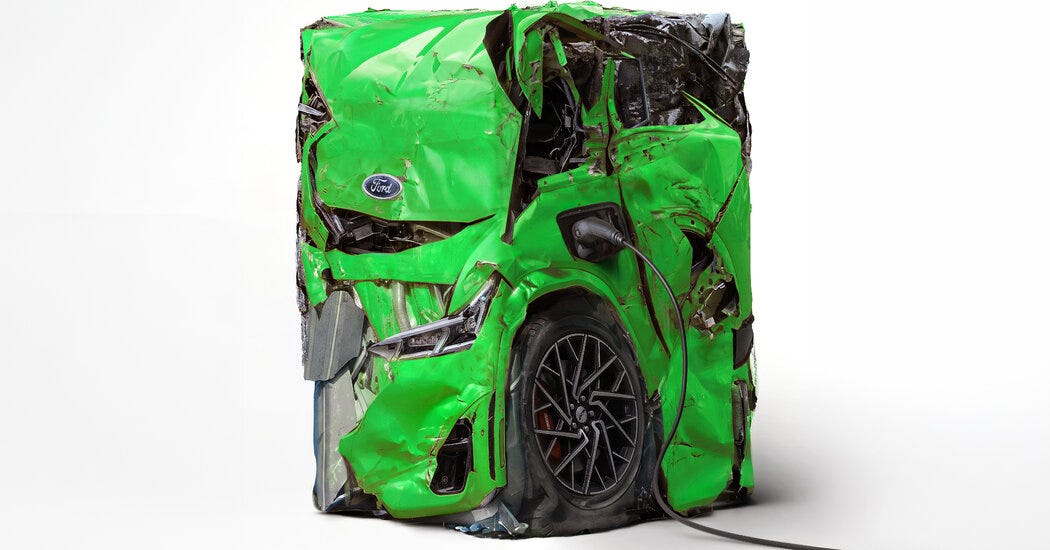
The American E.V. Has Been Crushed. Will It Take the U.S. Auto Industry With It? (Gift link) Matthew Shaer traces how Ford, G.M., Stellantis, and other automakers retreated from electric vehicles just as global adoption accelerated. Returning to profitable trucks and S.U.V.s may relieve the immediate financial pressure, but it also risks leaving the American industry dependent on technologies and supply chains developed elsewhere. (Matthew Shaer / The New York Times Magazine)
I tried Maxon’s free After Effects alternative, and I don’t want to go back. Paul Hatton has used After Effects for nearly two decades, but Maxon’s free Autograph won him over with GPU-powered motion design, compositing, and 3D tools in one application. The interface feels more like a 3D package than a familiar Adobe design tool, so switching won’t be frictionless. Built-in cameras, SVG extrusion, and native 2D/3D workflows still make it a substantial alternative without another subscription. (Paul Hatton / Creative Bloq)
The Internet Is Still Fun
From time to time, I will link to cool websites or apps. Here’s a batch for this week to make your Sunday a little brighter.
a11y.quest. Test yourself with 128 questions covering WCAG 2.2, semantic HTML, ARIA, keyboard access, and contrast. Dave Davies built it while studying for the Web Accessibility Specialist exam, while cautioning that the spec-correct answer doesn’t always serve real people best.
NameThatUI. A visual dictionary for those moments when you can describe a UI element but have no idea what it’s called. Entries identify the anatomy and implementation details, while guides translate more than 60 components across plain English, AppKit, and SwiftUI.
clipart.studio. Pick an old magazine from the Internet Archive, snip out anything that catches your eye, and assemble the pieces into a digital collage. You can also import your own PDFs, export the result, or hang it in the site’s public gallery.
Lunacy. This native Mac app resurrects Lunatic Fringe, the interactive space-shooter hidden inside the 1990s More After Dark screensaver collection, complete with an optional CRT shader and a gloriously unnecessary global leaderboard. You’ll need macOS 13 or later and your own copy of the original game module.
Thanks for sharing a11y.quest! I hope you found it useful.