


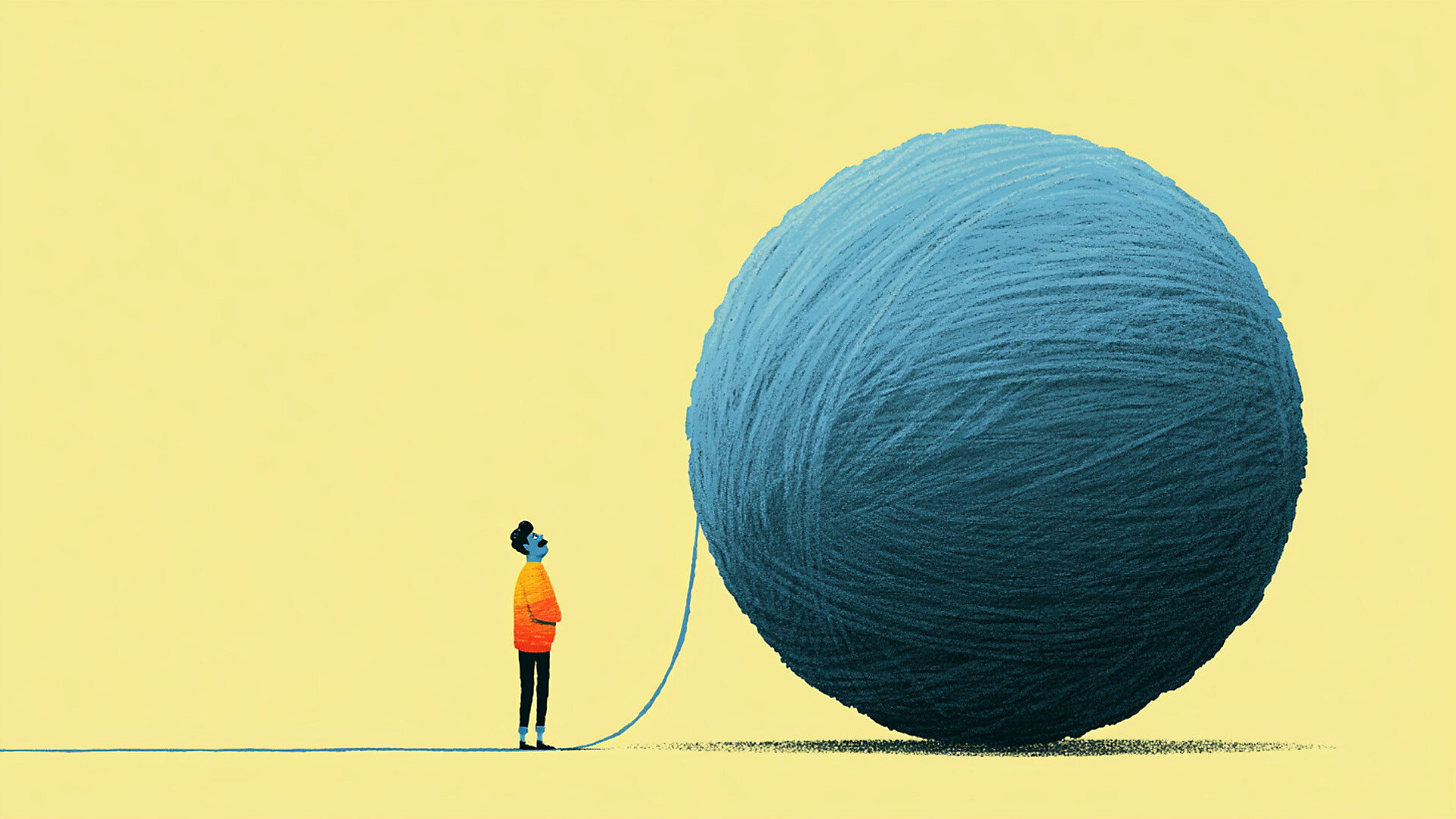
AI is becoming easier to use. The results still depend on what the person operating it knows.
Ethan Mollick has been testing models across jobs and workflows, and domain expertise predicts better agent results. Experienced people don’t merely get better final output. They get more useful work from each prompt. Mollick describes the change as a move from non-experts filling gaps with chatbots to experts managing agents that can carry out substantial work.
That distinction matters because AI can make a novice look competent very quickly. A generated interface may be clean, plausible, and functional. The person reviewing it still has to recognize a weak hierarchy, a false assumption about the user, or a workflow that falls apart under real conditions. Without that foundation, competent-looking output can be difficult to question.
Wouter de Bres provides a small example in his warning about “intuitive” design. Designers often use the word as if it were evidence, when it usually describes their own familiarity with the thing they made. A practiced designer knows to ask whose intuition is being measured. They also know that a better product can still lose to the one people already use. At 9:03am on a busy Tuesday, most people will stick with the routine they know.
Expertise can also be almost absurdly specific. Marcin Wichary’s 7,700-word interactive essay contains 38 playgrounds demonstrating how software fails our hands. He studies overlapping keystrokes, motor memory, dead zones, and one-frame delays. Responsiveness at finger scale can look like polish until someone who understands it shows how a tiny delay breaks flow. AI can produce another animation. It takes experience to know when removing the animation is the better decision.
The same effect is appearing at the organizational level. Ishan Gupta describes engineering teams shipping at multiples of their old speed and moving the bottleneck to product judgment. Once code becomes cheaper, deciding what deserves to be built consumes more of the team’s attention. The valuable engineer knows the domain, understands the customer, and can prove that the work is worth doing before sending agents after it.
Designers need that last part too. Marina Krutchinsky tells the story of a checkout redesign that cut abandonment by 35 percent but remained invisible to the CFO until the designer explained that the old flow was losing $1.2 million annually and the redesign had recovered $840,000 in two quarters. Design had to speak in money before the business understood its value. Domain knowledge includes the customer’s behavior and the economics around it.
There is an uncomfortable implication for people entering the field. If AI supplies competent output before someone understands the decisions inside it, they can skip the work that develops judgment. The shortcut works until the generated answer is wrong in a way they cannot see.
So I would use agents early, but I would pair the output with explanation. Why this hierarchy? What assumption did the model make? Which part would fail for a new user? What business result should change? The ability to answer those questions is evidence that the tool extended someone’s expertise rather than concealed its absence.
macOS Squircle Icons Are Fine
I appreciate the artistry behind distinctive Mac icons. I made my first one in ResEdit in 1990, pixel by pixel, and later worked with teams rendering Apple app icons at resolutions large enough for billboards. I understand why designers mourn the truck from Transmit, the vise from Compressor, and the bird from Twitterrific.
But oddly shaped icons have always created awkward click targets. In Mac OS X Tiger, clicking the empty space inside the square highlight around Automator or Chess could fail to select the icon because the active area followed the artwork. Apple’s uniform squircle also makes the hit area predictable. It is a small accessibility improvement, and I am fine with the trade.
What I’m Consuming
A History of Menus is a Menu of History. The Pudding turns the New York Public Library’s Buttolph Collection into an interactive history of American dining. Frank E. Buttolph spent decades assembling menus as records of culinary and social life; the companion collection lets you browse 5,000 menus from an archive of more than 25,000. Come for the typography and stay for the uncommon meats. (The Pudding)
BitTorrent’s disastrous, legendary, and controversial story. Janko Roettgers reconstructs the strange split between BitTorrent the protocol, the piracy ecosystem built around it, and the company that could never turn a revolution into a respectable business. Bram Cohen avoided Hollywood’s lawsuits by separating search and discovery from the protocol, then spent years discovering that legal insulation did not make the technology easy to monetize. His final admission is brutal: he gets nightmares about board meetings. (Janko Roettgers / The Verge)
GPT-5.6: Frontier intelligence that scales with your ambition. OpenAI is taking a page out of Anthropic’s book and releasing GPT-5.6 as a family rather than a single flagship: Sol for the most demanding work, Terra for everyday use, and Luna as the lower-cost option. The lineup reflects a maturing market, where model makers are competing on the mix of capability, speed, and price. (OpenAI)
Anthropic’s new “J-lens” reveals a silent workspace inside Claude. Michael Nuñez reports on Anthropic’s research into a “J-space” where Claude holds concepts it can report on and reason with without writing them down. Suppressing that workspace left simple classification largely intact but damaged multistep reasoning and creative generation. The researchers are careful not to claim phenomenal consciousness, but the functional resemblance to human conscious access is eerie. (Michael Nuñez / VentureBeat)
OpenTools / OpenPrinter. A compact, repairable printer with refillable cartridges, standard components, an integrated paper cutter, and open-source design files. You can print with only the black cartridge even when yellow is empty, which already makes it more humane than several printers I have owned. A cool idea that should not feel this radical. (Open Tools)
How a Nation of Immigrants Traces Its Roots. (Gift link) Albert Sun, Jeff Adelson, and Larry Buchanan map nearly 200 identities reported to the Census Bureau and show how migration, exclusion, work, and settlement produced America’s local patterns of ancestry. Greek sponge divers in Tarpon Springs, Yemeni autoworkers in Detroit, and Vietnamese shrimpers near New Orleans become visible in the census tracts. It is a beautiful demonstration that the country’s history of immigration is still legible in where people live. (Albert Sun, Jeff Adelson, and Larry Buchanan / The New York Times)