



“Defend the role, or follow the skill.” That’s Erika Flowers, writing in “The Last Typesetter“, and it’s the question I kept flibbertigibbeting on all week.
Figma’s State of the Designer 2026 calls it the “messy middle,” designers stretched between product management and engineering, occupying the translation layer between what should get built and how. It’s meant as a description of where designers are. Flowers argues it’s a description of what’s dissolving.
In another essay “Zero Stage to Orbit,” Flowers maps the design-to-development pipeline onto the rocket equation. Each stage compensates for the limitations of the previous one. Her inventory of the overhead is damning: research to inform design, design to spec for developers, specs to survive handoff, QA to catch what handoff broke, retros to discuss why QA caught so much. Fuel to carry fuel. The messy middle isn’t where designers are passing through. It’s the overhead the entire pipeline was built to manage.
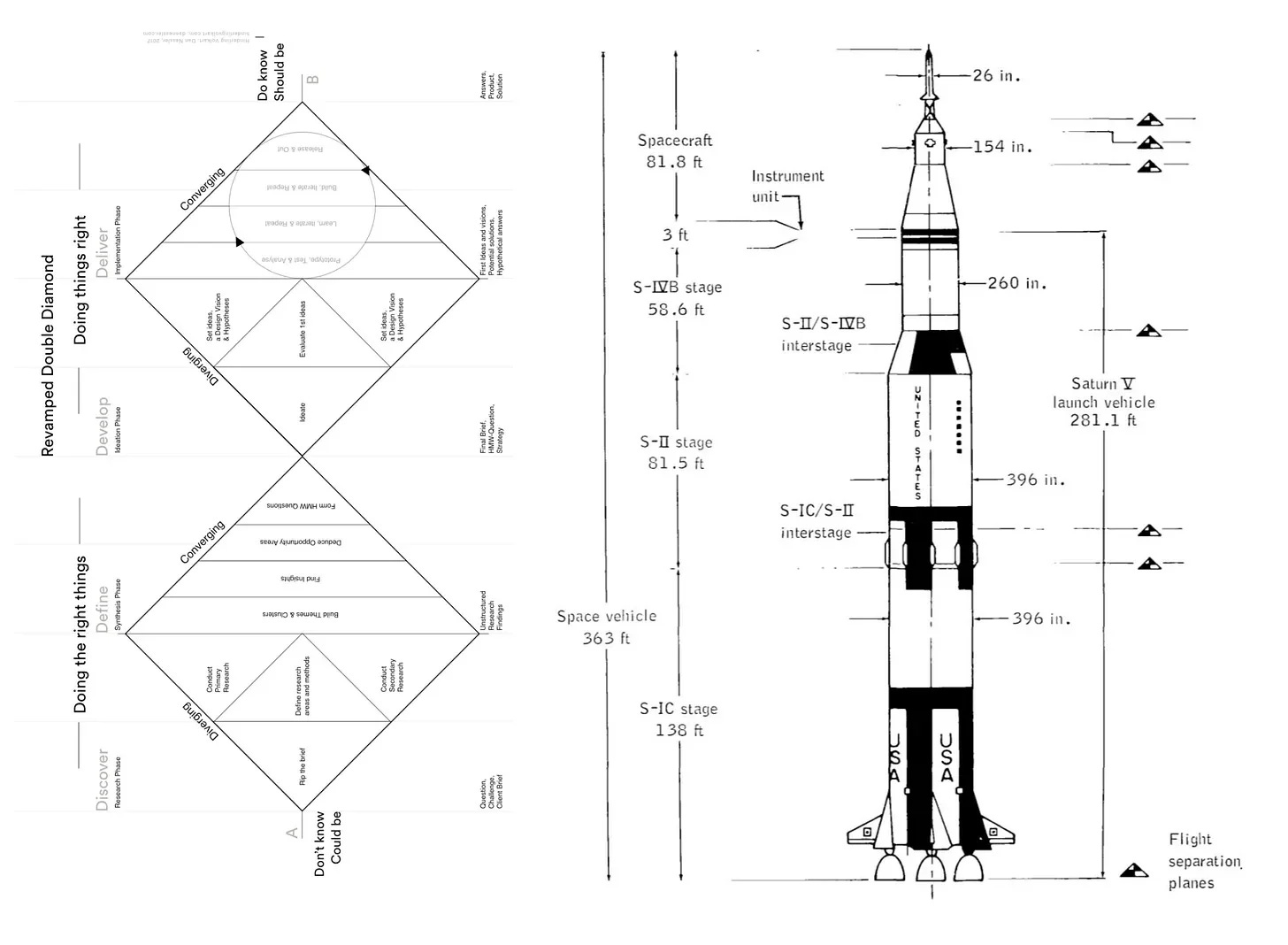
What AI changes is the gravity. When the distance between intent and artifact shrinks, the translation stages that justified all those roles start to collapse. Flowers frames this directly in her Zero-Vector Design curriculum: “Speed without intention is just faster failure. Speed with intention is leverage.” The skill that survives is intent: knowing what to build and what good looks like before you open any tool.
But intent only counts when you can make it real. Shreyas Doshi makes the case that good judgment compounds, and bad judgment compounds in the wrong direction. That’s why intent matters more than tooling. Jon Kolko takes a different turn, proposing that design is becoming a literacy, a way of understanding the designed world rather than making it. I get the instinct. But understanding without making is criticism. And intent that never ships is just taste with no consequences.
The designers closing that gap are moving in two directions, and both lead out of the middle. At Notion, Brian Lovin built a prototype playground so designers encounter reality before the mockup hardens into a spec. His phrase for it: “Encounter reality as early as possible.” David Hoang sketches unconstrained in code, then uses LLMs to snap his best ideas onto production components. The design system is the finishing move, not the starting point. Cameron Worboys flattened the org to three management layers and is pushing every designer to ship production code. Quality, he says, comes from reps and speed, not from “sitting in a cave for three months pontificating about the future of software.”
These look like engineering moves. They’re designers shortening the distance between intent and reality. Former Apple designers say they can’t spend months on lickable surfaces when the platform shifts every few months. The object of obsession has to move from the artifact to the system, from polished pixels to what Weber Wong calls escaping “artifact thinking”. The craft is in the intent. The tool is whatever gets it there fastest.
I worked in a desktop publishing service bureau in San Francisco during college. Down the street, traditional typesetting shops were still hanging on, but their business was already thinning. Within a few years those shops were gone. The people who understood typography, really understood it, landed on their feet. They became art directors, production managers, early web designers. The ones who only knew the machine didn’t.
That transition was real, and it wasn’t painless. This one won’t be either. The thing I’ve loved since 7th grade is changing shape. But the intent, the taste, the judgment, that part I’m holding onto. The containers will sort themselves out.
What I’m Consuming
How I’m Dealing with the Pressure to Adopt AI as a Designer. Martin Wright’s answer to AI anxiety is patience: wait six months, see which tools survive the hype cycle, then evaluate. His sharpest advice is to protect what he calls the “middle layer” of design work, the interpretation and judgment between inputs and outputs. He cites Anthropic’s 2026 study showing developers using AI scored 17% lower on comprehension tests. The people who delegated the thinking got the job done but understood less about what they’d built. (Martin Wright)
A Soft-Landing Manual for the Second Gilded Age. JA Westenberg uses postwar Berlin as a framework for navigating AI disruption: the Trümmerfrauen cleared 75 million cubic metres of rubble by hand, and within a decade Germany was thriving. The essay lays out a practical 10-year roadmap (guaranteed minimum income, universal basic services, public AI infrastructure, algorithmic governance) and draws on Jeff Atwood’s rural GMI initiative, David Graeber’s Bullshit Jobs, and Rutger Bregman’s Utopia for Realists. Neither doomer nor accelerationist, just stubbornly pragmatic. (JA Westenberg)
The Mythology of Conscious AI. Anil Seth, winner of the 2025 Berggruen Prize essay competition, argues that consciousness is unlikely to emerge from standard digital computation. Brains are not computers in any straightforward sense, and life, embodiment, and non-algorithmic processes may be prerequisites for conscious experience. A useful corrective to the anthropomorphizing that creeps in every time an AI model produces something that feels aware. (Anil Seth / NOEMA)
Bespoke AI Models Are the Next Big Thing in Filmmaking. Netflix acquired Ben Affleck’s AI startup InterPositive for roughly $600 million. The pitch: bespoke models trained on a production’s own dailies, so filmmakers can tweak lighting, remove rigging, or replace backgrounds in post without the uncanny slop of general-purpose generators. Charles Pulliam-Moore is rightfully skeptical about whether “empowering creatives” translates into actual benefits for the people doing the work. (Charles Pulliam-Moore / The Verge)
Grammarly Is Using Our Identities Without Permission. Grammarly’s “Expert Review” feature surfaces AI-generated writing advice “inspired by” real people, including Nilay Patel, Tom Warren, and Casey Newton, without their knowledge or consent. Stevie Bonifield found outdated job titles and fabricated expertise descriptions. Superhuman’s defense: the experts appear because their work is “publicly available and widely cited.” That’s not the justification they think it is. (Stevie Bonifield / The Verge)